
A wisdom tooth is not removed as a matter of principle. It is removed when it grows at an angle, becomes repeatedly infected or damages the neighbouring tooth; when it is well positioned, functional and cleanable, it is kept and monitored. The decision is made after an examination and a panoramic X-ray, and the quote is given to you before the procedure.
A wisdom tooth that is hurting you today: call 021 218 92 18. The practice is open Monday to Friday from 8am to 8pm and on Saturday from 9am to 3pm — see also dental emergencies.
Remove or keep: how the decision is made
Situations that lead to an extraction
- An impacted or partially impacted tooth — it stays under the gum or only partly comes through. The flap of gum covering it traps bacteria and is hard to clean.
- Repeated infections (pericoronitis): swollen, painful gum around the tooth, difficulty opening the mouth, sometimes fever.
- A tooth leaning against its neighbour — the second molar develops a cavity or the gum recedes from it at the point of contact, where no brush reaches.
- A cavity or a fracture in the wisdom tooth itself, when conservative treatment is not feasible in that location.
- Orthodontic preparation, when the orthodontist needs the space or wishes to protect the result of the treatment.
- A cyst or a lesion visible on the X-ray around the crown of the tooth.
Situations where it is kept
- It has come through straight, it meets the opposing tooth and you can brush it.
- It is impacted but symptom-free: no pain, no infection, no damage to the neighbouring tooth. It is then monitored at check-ups, with X-rays to support.
- It may be useful later, as a support for a bridge or in place of a lost molar.
The four wisdom teeth do not all behave in the same way: it can happen that two are removed and the other two stay.
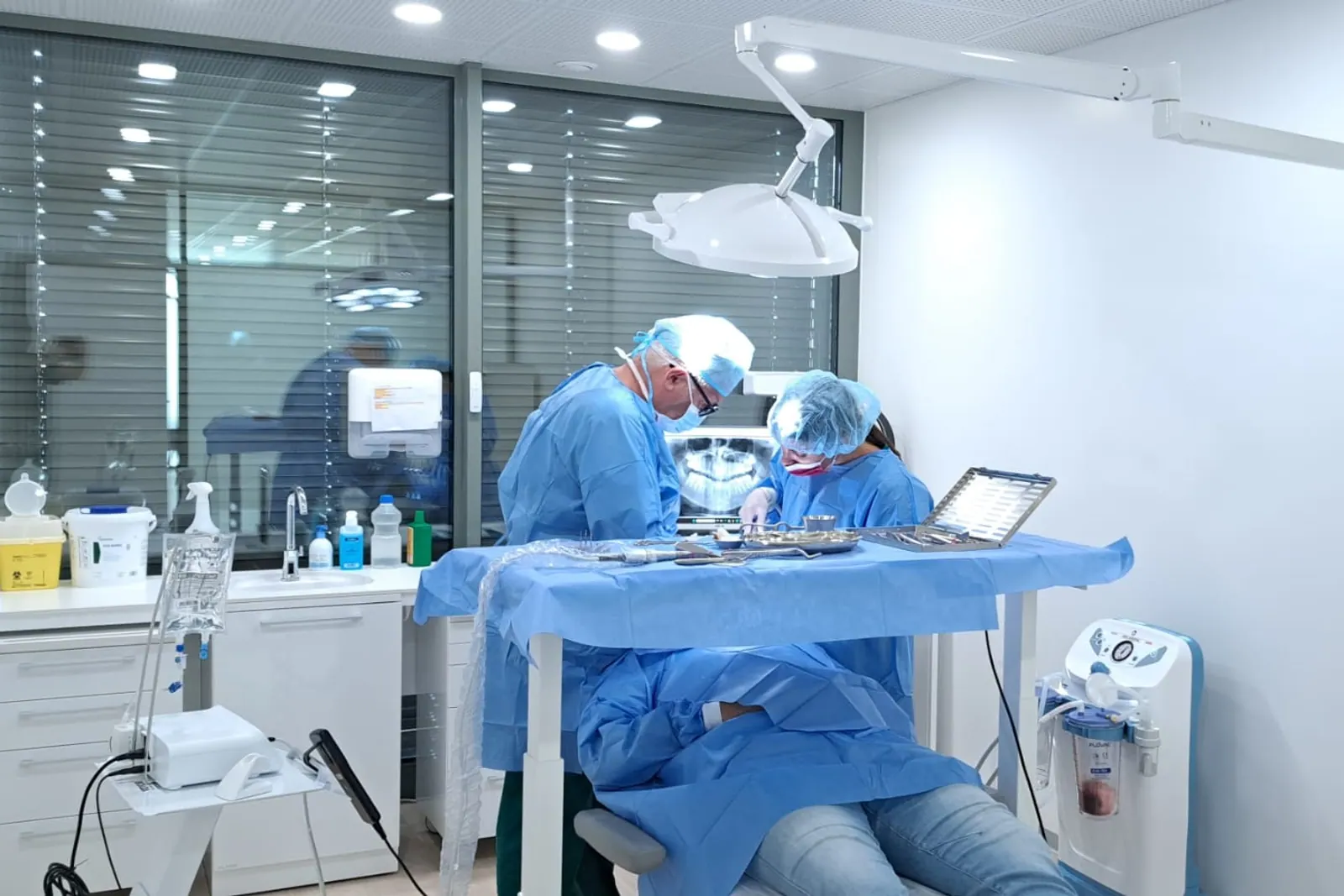
How the procedure goes
- Consultation and panoramic X-ray. The examination shows where the tooth lies, the shape of its roots and how they relate to the inferior dental nerve at the bottom and to the sinus at the top. When a root is close to the nerve, 3D imaging (cone beam) completes the assessment.
- Local anaesthetic. The area is numbed before the procedure. You stay awake and can tell us at any time what you feel.
- The procedure. A tooth that has come through is removed by loosening it. An impacted tooth requires a surgical approach: the gum is opened over a few millimetres, the tooth is freed and removed in one or several pieces, and the gum is then closed with stitches.
- Duration. A session generally lasts between twenty minutes and an hour, depending on the position of the tooth and the number of teeth removed.
- One tooth at a time or all four in one session. Both are done. For a long procedure, or for an anxious patient, general anaesthesia at the practice allows all four to be removed in a single session.
Your surgeon
These procedures are carried out by Dr Thierry Caro, oral surgeon at Cabinet Côté Gare, who works in oral and periodontal surgery. Meet him on the page for our team.
The days that follow
- The first two days. Swelling of the cheek and some discomfort are common, often at their peak on the second day. Cold applied from the outside, in periods of about ten minutes, limits them.
- What you eat. Cold and soft food on the first day, on the opposite side. No straw: suction dislodges the clot that protects the wound.
- To avoid for a few days. Sport, tobacco, alcohol, vigorous mouthwashes and very hot drinks.
- Medication. Painkillers, and an antibiotic when the situation calls for it, are prescribed to you at the end of the session, with the dosage.
- Stitches. When stitches have been placed, a check-up is scheduled about a week later; the stitches are removed then, unless they are dissolvable.
- Healing. The gum closes in 7 to 10 days. The bone rebuilds itself over two to three months.
- When to call the practice. Pain that increases from the third day, bleeding that does not stop, fever, an unusual taste or smell: call 021 218 92 18.
Price
The surgical extraction of a wisdom tooth — an impacted or partially impacted tooth whose removal requires opening the gum — starts at CHF 490.–. The final amount depends on the tooth, its position and the difficulty of the procedure: in Switzerland, each treatment is assessed in points according to an official scale, and the total is the number of points multiplied by the point value applied by the practice. A detailed treatment plan and a personalised quote are given to you at the first consultation, before any treatment begins: see the page Prices.
Frequently asked questions
Do all wisdom teeth have to be removed?
No. A wisdom tooth that is well positioned, functional and that you can brush is kept and monitored at check-ups. Extraction is discussed when it grows at an angle, becomes repeatedly infected or damages the second molar.
How much does a wisdom tooth extraction cost?
The surgical extraction of a wisdom tooth starts at CHF 490.–. The price then depends on the tooth, its position and the difficulty of the procedure: a tooth that has come through and an impacted tooth do not require the same work. Fees follow the official Swiss points scale (reference: Dentotar tariff) and the quote is given to you at the consultation, before the procedure.
Is the procedure painful?
It is carried out under local anaesthetic: the area is numbed before the procedure. Some discomfort and swelling are common for 24 to 72 hours, and painkillers are prescribed to you at the end of the session.
Can all four wisdom teeth be removed in a single session?
Yes, this is possible, under local anaesthetic or under general anaesthesia at the practice. The choice depends on the position of the teeth, the extent of the procedure and your preference; it is decided at the consultation.
How long do I need to rest afterwards?
Plan to spend the rest of the day quietly. After a tooth that has come through, resuming activities the next day is common; after an impacted tooth or several teeth removed in one session, allow two to three days.
At what age are wisdom teeth removed?
Most often between 16 and 25: the roots are not yet fully formed and healing is faster. An extraction remains possible later, depending on the clinical situation.
Is the extraction covered by insurance?
In Switzerland, basic insurance does not cover ordinary dental treatment. Supplementary insurance, or accident insurance when the tooth was hit in an accident, may contribute: the answer depends on your policy.
My wisdom tooth hurts, when can I be seen?
Call 021 218 92 18. The practice is open Monday to Friday from 8am to 8pm and on Saturday from 9am to 3pm, and severe pain counts as an emergency. In the meantime, cold applied to the cheek limits swelling; heat makes it worse when an infection is involved.
See also: Tooth extractions, Oral surgery, Dental emergencies.
